

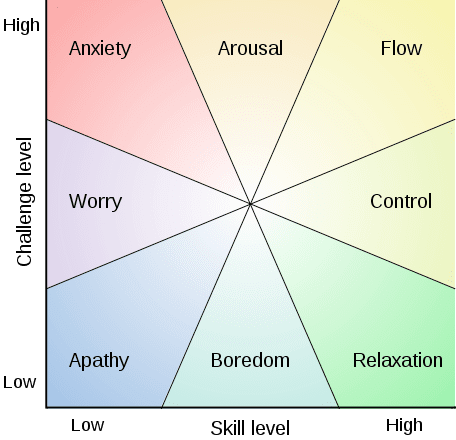
 Flow is the mental state of operation in which a person performing an activity is fully immersed in a feeling of energized focus, full involvement, and enjoyment in the process of the activity. Positive psychologist, Mihaly Csíkszentmihályi, first introduced this Flow Model and wrote about it in his book “Flow: The Psychology of Optimal Experience.”
A flow state can be entered while performing any activity, although most likely when wholeheartedly performing a task or activity for intrinsic purposes. Flow theory suggests three conditions to be met in order to achieve a flow state:
- One must be involved in an activity with a clear set of goals and progress.
- The task at hand must have clear and immediate feedback.
- One must have a good balance between the perceived challenges of the task at hand and his/her own perceived skills.
How do you know when you’re experiencing flow? These are 10 experiences identified with the flow state:
- Having a clear understanding of what you want to achieve.
- Being able to concentrate for a sustained period of time.
- Losing the feeling of consciousness of one’s self.
- Finding that time passes quickly.
- Getting direct and immediate feedback.
- Experiencing a balance between your ability levels and the challenge.
- Having a sense of personal control over the situation.
- Feeling that the activity is intrinsically rewarding.
- Lacking awareness of bodily needs.
- Being completely absorbed in the activity.
In education, there is a concept of overlearning. According to the Flow Model, overlearning enables the mind to concentrate on visualizing the desired performance as a singular, integrated action instead of a set of actions. Challenging assignments that stretch one’s skills can lead to a flow state.